
Bison Are Returning to their Native Homelands
But Trump, Burgum and his cattle-raising buddies want to kick them out

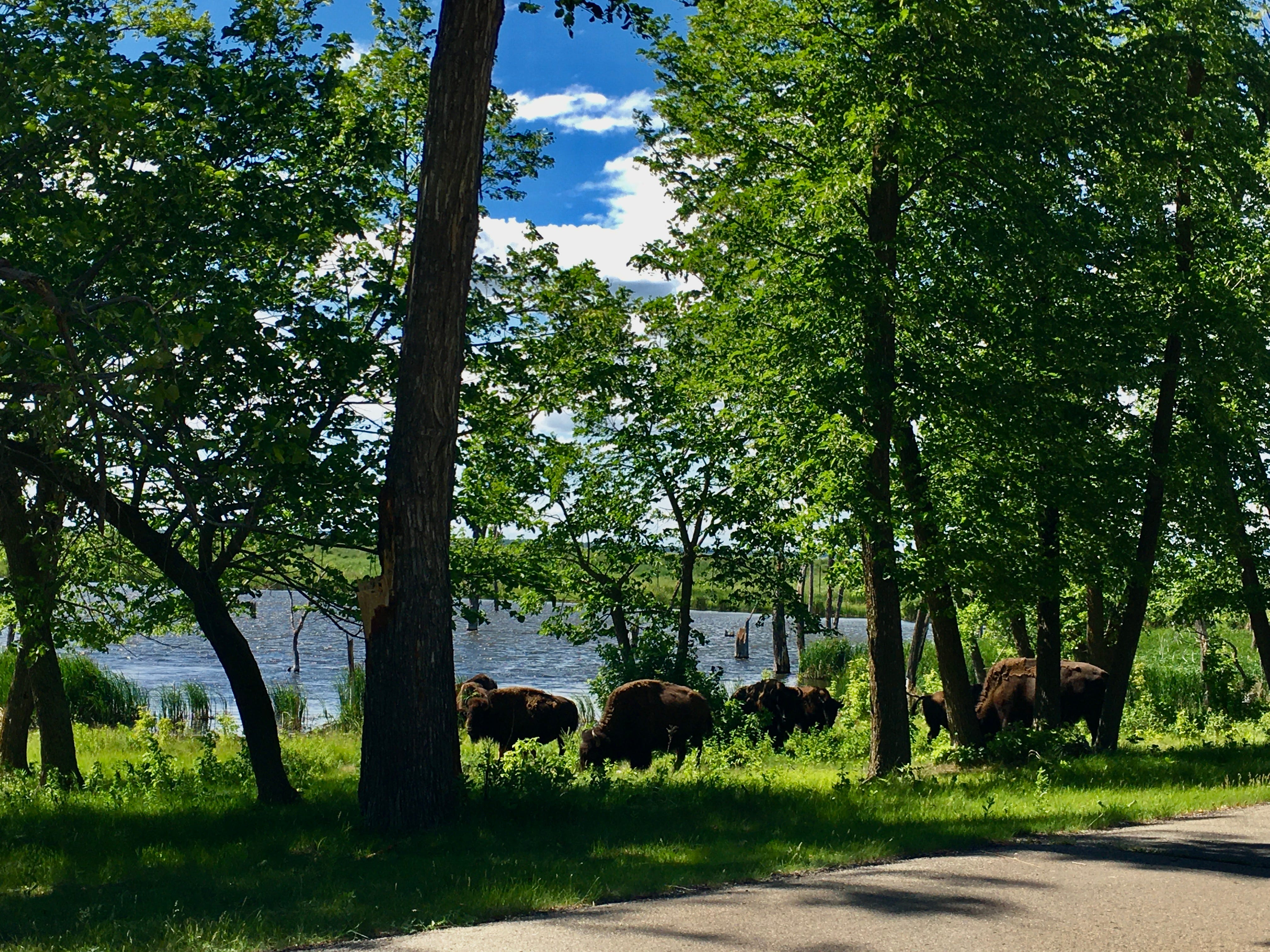
A few years ago, I spent some time on the Spirit Lake Reservation in North Dakota. It had been a long day, and I was about to drive back to Fargo. I asked the young woman I’d been interviewing, was there anywhere I should stop along the way? There was.
About 10 minutes later, I turned onto a small road. I gasped. There, just behind a fence near a sparkling clean river, were about nine or ten bison. Idly munching on the tall green grass. I quickly parked my rental car and got out. I stood near the fence, watching them. They didn’t look up; they were too busy eating. I had never seen bison in the wild. I did not expect the shaggy, slump-shouldered beasts to be so beautiful, or to move me so. I did not want to leave. If I could have, I would have camped there. I felt I was witnessing something ancient.
In the early 1800s, the American bison once numbered as high as 60 million. Over the next 100 years, they were slaughtered to near extinction. They were slaughtered to make way for the transcontinental railroad. They were slaughtered to make way for the relentless stream of European settlers descending on the prairie. They were also brutally killed because the buffalo was instrumental to the culture, traditions, and survival of Native Americans. If the bison were gone, the federal government reasoned, so, too, would be the Indians.
If you think I’m exaggerating, I suggest you watch The American Buffalo, Ken Burns’ epic PBS documentary. There are also god-awful photos of piles of bison skeletons online you can easily access.
But, incredible as it may seem, the bison are returning. And not to zoos, but to their ancestral homelands on the Great Plains. It took decades of efforts by various organizations, from The Nature Conservancy, which owns about 6,600 bison on 11 preserves in the U.S., to the InterTribal Council, a group of some 89 native nations working to restore their buffalo herds. But the bison population has risen to nearly half a million. For the first time in centuries, tribes from the Ft. Peck Reservation and Blackfeet Nation in Montana to the Osage in Oklahoma are renewing their connection with the buffalo. It’s a chapter of history I never thought I’d see.
But now even that hard-won victory is at risk. Last week, the Trump Administration and the Bureau of Land Management canceled grazing permits for about 900 bison in Montana privately managed by American Prairie. Never mind that the herd has grazed on public grasslands for more than twenty years. Trump wants to kick out the bison so his ranching buddies can graze cattle. And as the BLM stated so eloquently in its press release, American Prairie is only using the bison for conservation and ecological restoration “rather than as a production-oriented domestic livestock operation.”
In other words, it’s not killing them.
The whole thing stinks, involving, as it does, a conflict of interest with Karen Budd-Falen, a top deputy in the Interior Department, and her boss Doug Burgum. Thankfully, Earthjustice has filed a lawsuit. If you’d like to know more, High Country News has a terrific story. But it makes me worry: what’s to stop them from going after the bison managed by tribes?
I think bison are fascinating. I can’t tell you exactly why. Maybe because they don’t like to be herded, and they’re a matriarchal species? And because they’re not keen on tourists at Yellowstone who treat them like big furry pets? It’s not like I grew up around bison. Although my family is from Oklahoma, and my grandmother was Chickasaw, I grew up by the Pacific Ocean. About as far from the prairie as a beach girl can get. I didn’t visit Oklahoma until I was 16, and then I hated it.
Oh my god, the heat and humidity! I remember sitting in my Great Aunt’s living room furiously fanning myself with a magazine because she didn’t have air conditioning. You couldn’t even get relief from a swimming pool. I couldn’t get my bearings because there wasn’t a horizon. Or at least one I could grasp.
But after many visits, and maturing since adolescence, I’ve since come to appreciate Oklahoma, its singular beauty and the biodiversity of the prairie. Which wouldn’t exist without bison.
If you’d like to protect this iconic animal from Trump, here are a few salient facts to tell your representatives:
--Bison was named the national mammal of the United States in 2016. It’s also the state mammal of Oklahoma.
--Bison are the largest land mammal in the United States.
--Bison are a keystone species for grasslands. Their grazing patterns and “wallowing”--where they plop down and roll around in the soil to groom themselves and nourish their skin--increase the growth of wildflowers, plants, and insects.
--Males can weigh up to a ton.
--Bison are fast. They can run up to 35 mph.
--Their full Latin name is bison bison bison.
Isn’t that cool?
Other news, briefly:
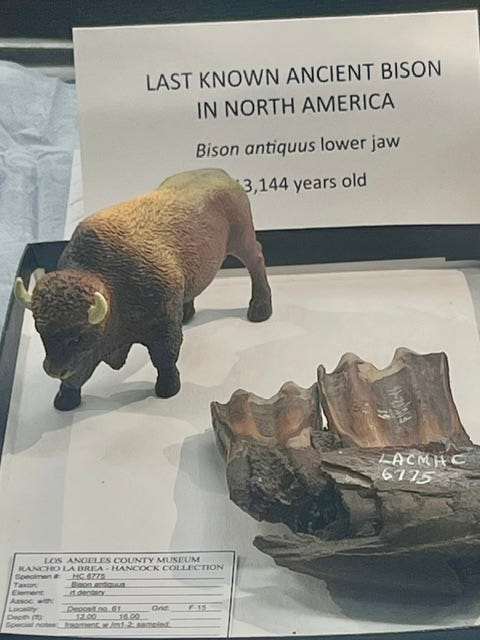
On July 7, the La Brea Tar Pits Museum in Los Angeles will be closing for a two-year renovation to prepare for the 2028 Summer Olympics. I went the other night and got an inside peek at the museum’s enormous collection of Ice Age fossils, including trays of dire wolf skulls and sloth metatarsals. Outdoors are several large excavation sites, where you can see--and smell--the primordial tar pits that trapped mammoths and saber-tooth tigers. They continue to yield amazing scientific finds that will help us with our own climate change dilemmas. Did you know that the area where Los Angeles is today was once under the Pacific Ocean? Fun, right?
I hate fire season in Southern California. Which is now seemingly endless. It’s only the third week in May, yet a fire is blazing in Simi Valley and thousands have had to evacuate. Another is chewing up the Channel Islands, one of our newest national parks, after a stranded sailor set off a flare to ask for help. This is why we have fires— because of careless humans.
Next week, I’ll be writing about Switzerland!
Thanks for reading, as always.
Mona
I loved seeing them in Yellowstone. I admired how they don't rush as they amble along, even if a line of cars is waiting for them to cross the road.